
Enzymes are biological catalysts that control the rate of chemical reactions in living organisms. They make essential life processes happen at speeds required for the maintenance of life functions. Without them, biochemical reactions occur far too slowly to sustain life. In this post, we will be exploring what enzymes are, how they work, factors influencing enzyme functioning, and their fascinating role.
Enzymes are proteins. Think of them as highly specialized machines. They each have a specific function, and they are efficient in completing it. Chemical reactions sometimes require extreme conditions, but enzymes allow these reactions to occur in our bodies and at a faster rate.
Lock-and-key Model
To understand the functioning of enzymes, we will now understand the lock and key model. This model is very specific to substrates. The enzyme’s active site is the lock, and the substrate (molecule the enzyme is acting on) is the key. Only the right substrate will fit in the enzyme’s active site, which is the special region where the reaction occurs. When the substrate and active site and bonded (temporary bonding), this is referred to as enzyme enzyme-substrate complex. The enzyme will then act on the substrate and release it from the active site, making the enzyme available to combine with other substrates. Enzymes can either break down substrates (catabolic reactions) or build substrates (anabolic reactions).
How these reactions take place is due to the alteration in activation energy. Activation energy is the energy needed for a reaction to occur. Enzymes work by lowering the activation energy to allow the reaction to occur faster and efficiently.
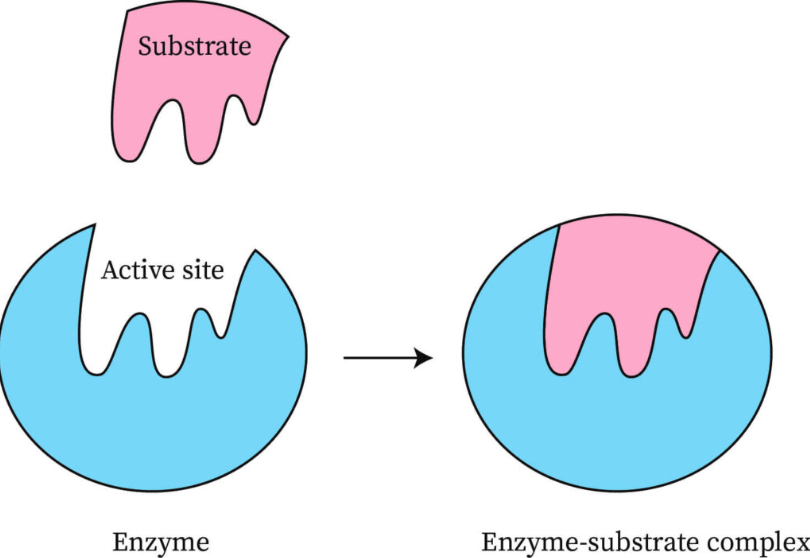
Figure 1. Enzyme Lock and Key Model
Functioning
Enzymes are present everywhere in your body. A few examples are:
- Digestive system
- Amylase breaks down carbs
- Pepsin breaks down proteins
- Lipase breaks down fats
These enzymes help the digestive system efficiently break down macromolecules for further processes. Without these, your food would be undigested for days.
- Cellular Respiration
Enzymes break down glucose during cellular respiration to produce ATP, which is the energy currency of your body and the most important molecule. Without enzymes, the production of ATP wouldn’t be possible, and neither would any other metabolic process.
- DNA replication and the Central Dogma
As discussed in the post on the central dogma, enzymes make it possible for your DNA to communicate the code to the rest of the body. These enzymes also help DNA synthesis when cells divide.
These are just a few examples of enzymes in your body. Enzymes have many more endless functions. They are not just helpful but essential. Many biochemical and essential life processes simply wouldn’t occur without them. Life, without enzymes, would be biologically impossible. Additionally, enzymes aren’t just useful in your body but in all kinds of industries such as food, biotechnology, medicine, etc.
Factors affecting enzyme activity
Enzymes work best under specific conditions, and some factors can alter their functioning. Let’s understand this better.
- Temperature
Each enzyme has an optimum temperature. Raising the temperature generally speeds up a reaction. However, extremely high temperatures cause an enzyme to lose its shape (denature) and stop functioning. At low temperatures, the no. of successful collisions between the enzymes and substrates is reduced as the molecular movement decreases (less kinetic energy) and the reaction is slowed down.
- pH
Each enzyme also has an optimum pH range. Changing the pH outside of the range will slow down enzyme activity, and extreme pH values can cause the enzymes to denature. For example, pepsin in the stomach works best in acidic conditions (pH ~2)
- Enzyme concentration
Increasing enzyme concentration speeds up the reaction as long as there is substrate to bind to. Once all the substrate is bound, the reaction will no longer speed up, since there will be nothing for additional enzymes to bind to.
- Substrate concentration
Increasing substrate concentration also increases the rate of reaction to a certain point. Once all of the enzymes have bound, any substrate increase will have no effect on the rate of reaction, as the available enzymes will be saturated and working at their maximum rate.
To conclude, enzymes are the hidden heroes of biology. They may be invisible to the naked eye, but they are responsible for almost every reaction keeping you alive. They are precise, efficient, and designed to make life possible. Next time you break or blink remember there is a tiny enzyme making it happen behind the scenes.
 LifeLine
Leave a comment