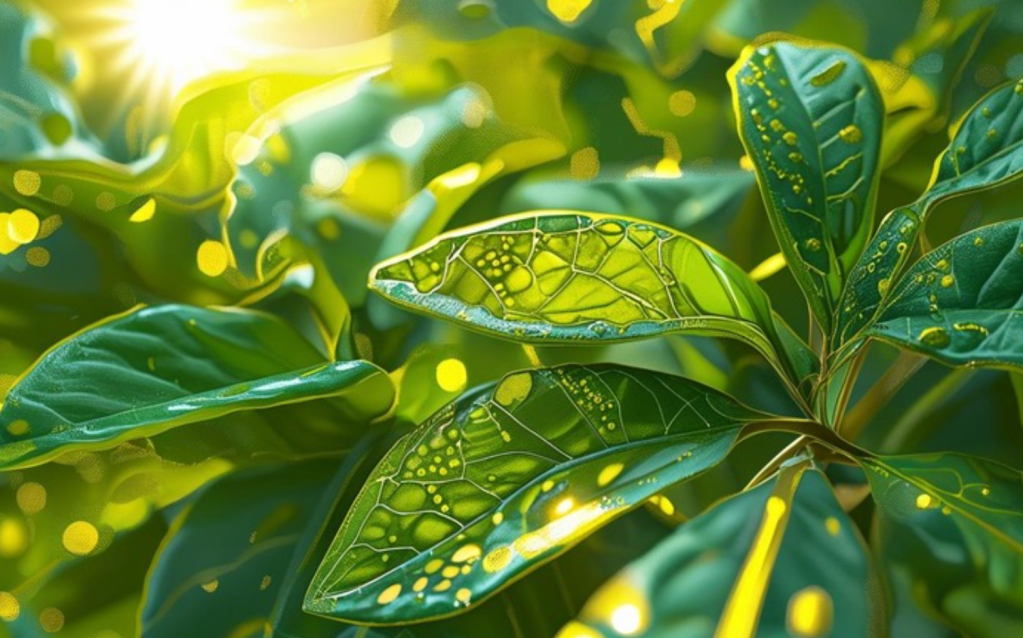
Leaves are powerful structures. They are the powerhouses of plant life. They play a vital role in producing the food that sustains not only the plant itself, but nearly all life on Earth.
Structure of Leaf
Leaves come in many shapes and sizes, but most have a common structure: The stomata pores are more on the lower side of the leaf as it is not directly exposed to the sun. The stomata may get ruptured because of the intense radiation of the sunlight. It’s on the underside of the leaf to protect stomata from the high radiation of the sunlight. Stomata’s close at night to limit transpiration and save water. Light induces the opening of stomata to enhance CO2 uptake. Tiny pore openings in the plant tissue that allow gas exchange. There are also guard cells that surround stomata, their function is to open and close the pores to control gas exchange and water transpiration. In very hot conditions water inside the leaf evaporates and the water vapor can escape through the stomata. Closing them prevents water loss but limits diffusion.
Waxy cuticle: reduces water loss, a hydrophobic coating
Upper epidermis: tightly packed, allows light to pass through
Palisade mesophyll: Tightly packed, Main site of photosynthesis (contains chloroplast)
Spongy mesophyll: Irregular shape, Intercellular space for Gas exchange
Xylem: vascular tube, transports water, flows run only in 1 direction
Phoem: Vascular tube, Transports products noth up and down
Bundle sheath: surround xylem and phloem, specialized photosynthesis for plants in dry area
Stoma: water loss through transpiration, guard cells
Chloroplast Structure
The most important function of the chloroplast is to synthesize food by the process of photosynthesis. They contain a pigment known as Chlorophyll. Chlorophyll is essential for photosynthesis. It captures sunlight and goes ahead with the process of photosynthesis by converting it to chemical energy.
Grana: stacks of disc-shaped structures known as thylakoids or lamellae. The grana of the chloroplast consist of chlorophyll pigments and are the functional units of chloroplasts. These are the sites of conversion of light energy into chemical energy.
Stroma: a homogeneous matrix that contains grana and is similar to the cytoplasm in cells in which all the organelles are embedded. Stroma also contains various enzymes, DNA, ribosomes, and other substances. Stroma lamellae function by connecting the stacks of thylakoid sacs or grana.
Thylakoid System (Lamellae): a collection of membranous sacs called thylakoids or lamellae. It is the site for the process of light-dependent reactions in the photosynthesis process. The thylakoids are arranged in stacks known as grana, and each granum contains around 10-20 thylakoids.
Chlorophyll:a green photosynthetic pigment that helps in the process of photosynthesis. They are found in the thylakoid membranes.
To conclude, leaves help sustain ecosystems, support food chains, and maintain the balance of gases in the atmosphere. The leaf works quietly to keep the planet alive.
 LifeLine
Leave a comment