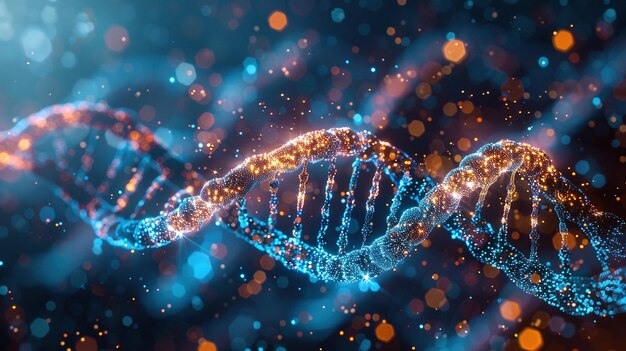
Every living thing on Earth from the tiniest bacteria to towering trees and human beings all shares a biomolecule that holds the instructions for life known as DNA. DNA contains the instructions needed for an organism to develop, survive and reproduce. To carry out these functions, DNA sequences must be converted into messages that can be used to produce proteins, which are the complex molecules that do most of the work in our bodies. DNA is a polymer of a nucleotides.
DNA is located in the nucleus of most cells, packed into structures known as chromosomes. Humans have 46 chromosomes (23 pairs), each coding for thousands of genes. DNA, short for Deoxyribonucleic Acid, is a molecule that contains the genetic instructions used in the development and functioning of all known living organisms and many viruses. It is often referred to as the “blueprint of life” because it carries the genetic information required for the growth, development, functioning, and reproduction of living organisms.
DNA is a long, double-stranded helical structure composed of smaller units called nucleotides. Each nucleotide consists of a sugar molecule (deoxyribose), a phosphate group, and one of four nitrogenous bases: adenine (A), thymine (T), cytosine (C), and guanine (G). The base pairs form complementary bonds, with adenine always pairs with thymine, and cytosine always pairing with guanine. This pairing is essential for the replication and transmission of genetic information during cell division.
The sequence of these nucleotides along the DNA molecule contains the genetic code, which determines the specific characteristics and functions of an organism.
The process by which DNA directs the synthesis of proteins is known as protein synthesis or gene expression. Genes, which are specific sequences of DNA, contain the instructions for making proteins that carry out various functions within the body.
DNA plays a vital role in inheritance, as it is passed down from one generation to the next. Mutations, changes in the DNA sequence, can occur over time, leading to genetic variation and evolution in populations.
Nucleic acids are a class of biomolecules that play a fundamental role in the storage and transmission of genetic information in living organisms. There are two primary types of nucleic acids:
Deoxyribonucleic Acid (DNA)
- DNA is a double-stranded molecule that contains the genetic code for the development, functioning, growth, and reproduction of all known living organisms.
- It consists of four types of nucleotide building blocks: adenine (A), thymine (T), cytosine (C), and guanine (G).
- The specific sequence of these nucleotides along the DNA strand encodes the genetic instructions for building proteins and other cellular components.
- DNA is typically found in the cell nucleus in eukaryotic cells and in the nucleoid region in prokaryotic cells.
Ribonucleic Acid (RNA)
- RNA is a single-stranded molecule that plays various roles in protein synthesis and gene regulation.
- It also consists of adenine (A), cytosine (C), and guanine (G), but instead of thymine (T), RNA contains uracil (U).
- There are several types of RNA, including messenger RNA (mRNA), transfer RNA (tRNA), and ribosomal RNA (rRNA), each with specific functions in protein synthesis.
- RNA is found throughout the cell, including the nucleus and cytoplasm.
Nucleic acids are critical to life because they contain the instructions necessary for the synthesis of proteins, which are the workhorses of cellular processes. DNA serves as the long-term storage of genetic information, while RNA carries out the immediate tasks of decoding and using that information to build proteins and regulate gene expression. Together, DNA and RNA are essential components of the genetic machinery in all living organisms.
 LifeLine
Leave a comment