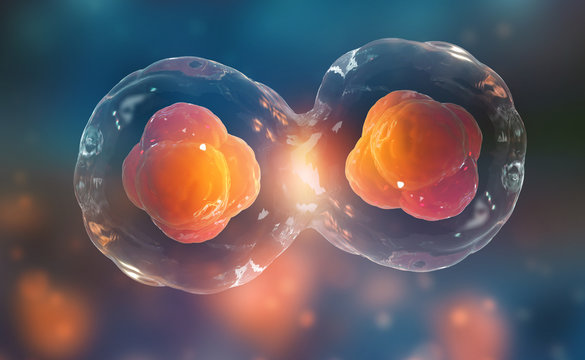
Mitosis is the way eukaryotic cells divide to make identical copies of themselves. It’s the phase of the cell cycle where the nucleus of a cell is divided into two nuclei with an equal amount of genetic material in both the daughter nuclei. Mitosis is essential for the growth of the cells and the replacement of worn-out cells. Without mitosis, life as we know it would come to a halt. It is an equational division, so it doesn’t occur in gamete cells.
Stages of Mitosis
Right before prophase, the cell spends most of its life in the interphase, where preparations are made before the beginning of mitosis (the DNA is copied). However, since the actual process involves the division of the nucleus, the prophase is technically the first stage of this process.
The different stages of mitosis occurring during cell division are given as follows:
Interphase
Before entering mitosis, a cell spends a period of its growth under interphase. It undergoes the following phases when in interphase:
- Cell grows and copies its DNA before moving to mitosis.
- G1 Phase: This is the period before the synthesis of DNA (growth of cell)
- S Phase: This is the phase during which DNA synthesis takes place.
- G2 Phase: This is the phase between the end of DNA synthesis and the beginning of the prophase (Organ grows themselves).
- Cell spends 90% in interphase.
Prophase
The process of mitosis begins with the prophase. In this stage, the chromatin condenses and the nucleolus disappears.
Prophase immediately follows the S and G2 phases of the cycle and is marked by condensation of the genetic material to form compact mitotic chromosomes composed of two chromatids attached at the centromere.
The completion of the prophase is characterized by the initiation of the assembly of the mitotic spindle, the microtubules and the proteinaceous components of the cytoplasm that help in the process.
The nuclear envelope starts disintegrating.
Metaphase
Metaphase is the second stage of the process, chromosomes get condensed at the equator, before being split apart for each of the two daughter cells.
At this stage, the microtubules start pulling the chromosomes with equal force and the chromosome ends up in the middle of the cell. This region is known as the metaphase plate. Thus, each cell gets an entire functioning genome.
Anaphase
The splitting of the sister chromatids marks the onset of anaphase. These sister chromatids become the chromosome of the daughter nuclei. The chromosomes are then pulled towards the pole by the fibers attached to the kinetochores of each chromosome. The centromere of each chromosome leads at the edge while the arms trail behind it.
Telophase
The chromosomes that cluster at the two poles start coalescing into an undifferentiated mass, as the nuclear envelope starts forming around it. The nucleolus, Golgi bodies and ER complex, which had disappeared after prophase started to reappear.
Telophase is followed by cytokinesis, which denotes the division of the cytoplasm to form two daughter cells. Thus, it marks the completion of cell division.
Cytokinesis
This is the division of the cytoplasm and other cell organelles into two daughter cells. In animal cells, a cleavage furrow forms and pinches the cell into two parts. In plant cells, a cell plate forms between the divided nuclei, gradually developing into a new cell wall.
The cleavage furrow is the action of the cell’s surface that begins the progression of cleavage, by which animal and some algal cells undergo cytokinesis, the final splitting of the membrane, in the process of cell division.
Mitosis is one of the most fundamental processes of life. It ensures continuity from one cell generation to the next.
 LifeLine
Leave a comment