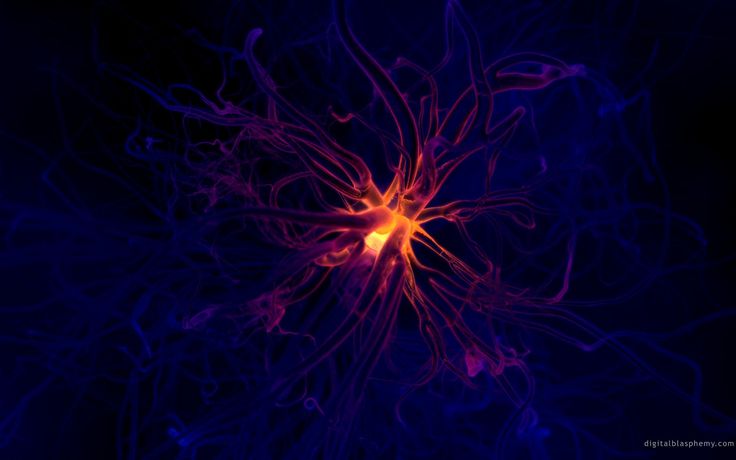
Neurons (also called nerve cells) are the fundamental units of the brain and nervous system, the cells responsible for receiving sensory input from the external world, for sending motor commands to our muscles, and for transforming and relaying the electrical signals at every step in between.
Structure of Neuron
Dendrites – Their purpose is to receive information from other neurons and to transmit electrical signals to the cell body. Dendrites are covered in synapses, which allow them to receive signals from other neurons. Some neurons have short dendrites, whilst others have longer ones.
Nucleus – The soma contains a cell nucleus that produces genetic information and directs the synthesis of proteins. These proteins are vital for other parts of the neuron to function.
Soma (Cell Body) – The soma’s function is to maintain the cell and to keep the neuron functioning efficiently. The soma is enclosed by a membrane that protects it but also allows it to interact with its immediate surroundings.
Axon – The function of the axon is to carry signals away from the cell body to the terminal buttons in order to transmit electrical signals to other neurons. Some axons are covered in a fatty substance called myelin which insulates the axon and aids in transmitting signals more quicker.
Myelin Sheath – The myelin sheath is a layer of fatty material that covers the axons of neurons. Its purpose is to insulate one nerve cell from another and so to prevent the impulse from one neuron from interfering with the impulse from another. The second function of the myelin sheath is to speed up the conduction of nerve impulses along the axon.
Node of Ranvier – Periodic gap in the insulating sheath (myelin) on the axon of certain neurons that serves to facilitate the rapid conduction of nerve impulses.
Schwann Cell – Type of glial cell that surrounds neurons, keeping them alive and sometimes covering them with a myelin sheath, and are the major glial cell type in the peripheral nervous system.
Axon Terminal – Located at the end of the neuron, the axon terminals (terminal buttons) are responsible for transmitting signals to other neurons.
Types of Neurons
Sensory Neurons
The sensory neurons convert signals from the external environment into corresponding internal stimuli. The sensory inputs activate the sensory neurons and carry sensory information to the brain and spinal cord. They are pseudounipolar in structure.
Motor Neurons
These are multipolar and are located in the central nervous system extending their axons outside the central nervous system. This is the most common type of neuron and transmits information from the brain to the muscles of the body.
Interneurons
They are multipolar in structure. Their axons connect only to the nearby sensory and motor neurons. They help in passing signals between two neurons.
The Action of Neuron
Two neurons dominate the pathway, afferent nerves (receptor) and the efferent nerves (effector)
Below is a brief description of the events that take place:
- Firstly, it begins with a receptor detecting the stimulus or a sudden change in the environment, where the instinct again has a role to play. The stimulus is received from a sensory organ.
- Then, the sensory neuron sends a signal to the relay neuron.
- This is followed by the relay neuron sending the signal to the motor neuron.
- Further, the motor neuron sends a signal to the effector.
- The effector produces an instantaneous response, for example, pulling away from the hand or a knee-jerk reaction.
Neurons may be small but they together work to power every thought, action, movement, memory, and sensation in your body.
 LifeLine
Leave a comment